
Seasonal Wellness
Written by Dr. David Dow
4 min read

If you’ve lived here through more than one October, you already know how this goes. You walk to get coffee in shorts on Saturday, and by Monday morning you’re hunting for the ice scraper you swore was in the trunk.
I love that about living here, for the record. It keeps us humble. But I can also tell you that my schedule knows when a front is coming before the forecast does, because the same thing happens every year. Somebody walks in, lowers themselves into a chair a little more carefully than usual and says, “I think I’m just getting old.”
You’re not getting old. Well, we all are, but that’s not what happened on Monday. What happened is that the weather changed faster than your body could keep up with, and I’d like to explain why, because once you understand it you can do something about it.
Your neighborhood wrote the record book
Here’s a bit of trivia for your next block party. For decades, Denver’s official weather was measured at the old Stapleton airport, which means a good chunk of this city’s weather history was recorded right here in our neighborhood.
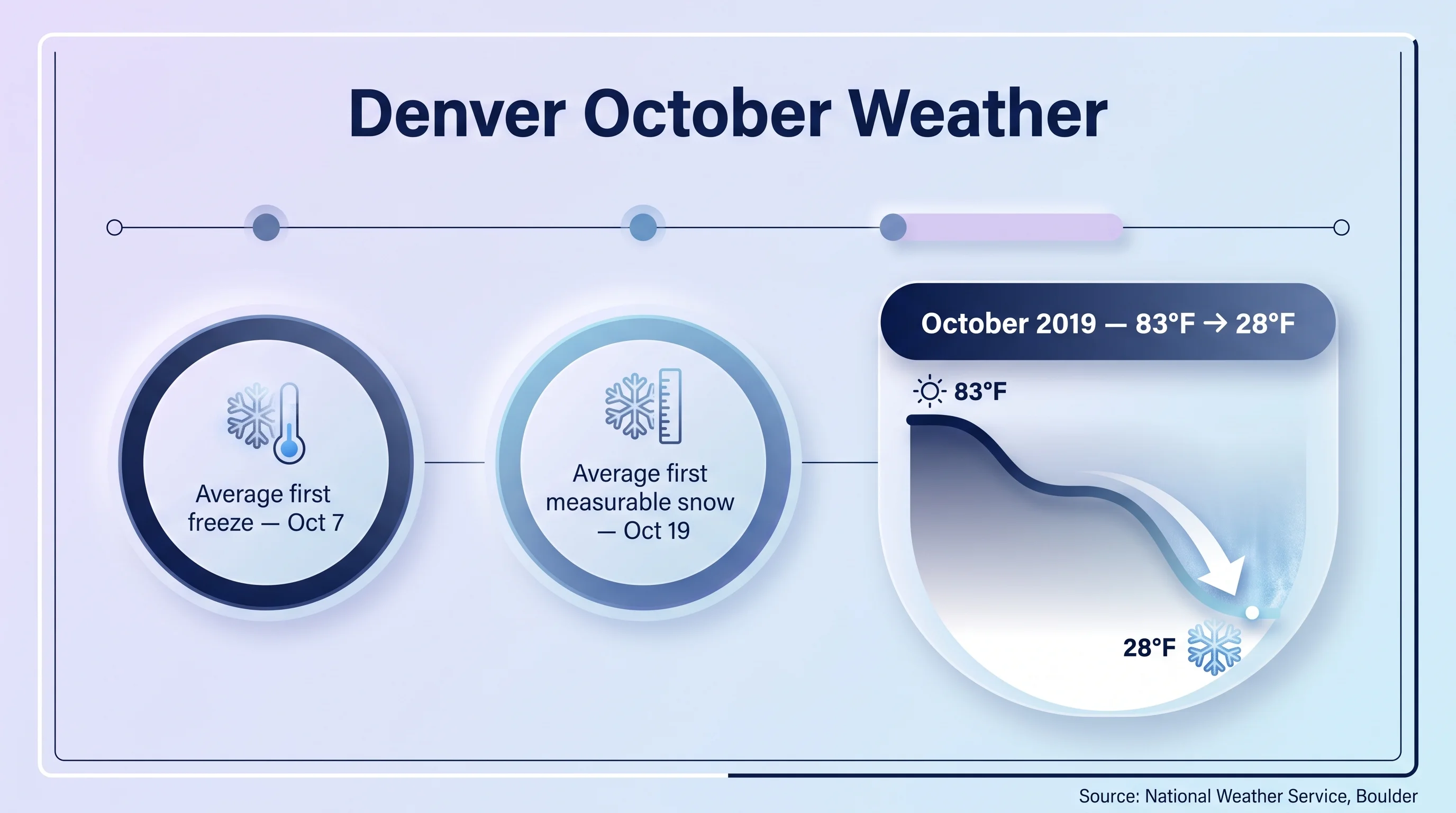
And what a history it is. According to the National Weather Service, our average first freeze lands around October 7, and our average first measurable snow arrives around October 19. Those are only averages, of course. I remember an October a few years back when we went from 83 degrees to the 20s in about a day, and I’m fairly sure half of Central Park still had tomatoes on the vine.
So when I say our bodies get whiplash this time of year, I mean it almost literally.
“Is it all in my head?”
I get asked this constantly, usually a little sheepishly, as if feeling the weather in your knee were something to be embarrassed about. It isn’t, and you’re in very good company.Researchers have been chasing this question for years, and I’ll give you the honest version, which is that they’re still arguing about the details. One of the largest studies followed more than 2,600 people for 15 months using their smartphones, and it found that pain tracked with humidity, air pressure and wind. Temperature on its own didn’t show much.
Other studies, especially of people with arthritic knees, found that pain did climb as the thermometer dropped. What I take from all of it matches what I’ve seen in practice for years. Cold by itself isn’t really the villain. Change is. A steady cold week bothers people far less than a wild swing, and wild swings happen to be our local specialty.

So what’s going on in there?
Nobody has this completely nailed down, but here are the best explanations we have, in plain English. When a front rolls in, the air pressure around you drops. That pressure normally pushes gently on your body from every direction, and when it eases off, the tissues around your joints may expand ever so slightly. In a healthy joint you’d never notice. In one that’s already irritated or stiff, that little bit of extra swelling can be enough to get your attention.
Meanwhile, the fluid that lubricates your joints is thought to thicken up in the cold, a bit like honey that’s been sitting in a chilly pantry. Your muscles tighten to hold heat, your shoulders creep up toward your ears, and you start moving less because the couch suddenly looks fantastic.
That last one matters more than people realize. Your joints don’t have much blood supply of their own, so they depend on movement to pump nutrients in and waste out. When you stop moving they stiffen, and when they stiffen you feel like moving even less. You can see where that’s headed. And then it snows.

The first shovel of the year
If I could put one warning on a billboard along Central Park Boulevard, it would be about this. Our first real snow catches a body that has spent two or three weeks slowly tightening up, and then asks it to bend, lift and twist a few hundred times before breakfast, in the cold, without any warm-up.
Most of the sore backs I hear about after a first snow didn’t start with the shovel. They started weeks earlier, with a spine that had quietly lost some of its movement, and the shovel was simply the last straw.
Here’s what I’d do about it, starting this week:
Warm up before you head out. Five minutes of marching in place, arm circles and gentle twists gets that honey flowing again.
Move every day, even when it’s gray. A 20 minute walk around the block counts for more than you’d think.
Keep your low back and neck warm. Muscles that are guarding against cold are muscles waiting to seize up.
Drink water like it’s July. Our air is dry all year, and you won’t feel as thirsty when it’s cold.
Push snow when you can. When you have to lift, take small loads and turn your feet instead of twisting.
What your joints are really telling you
I’ll leave you with how I think about all of this. Weather doesn’t create problems so much as it reveals them. A joint that moves well tends to shrug off a pressure swing, while one that’s been stiff since summer is going to be the first to complain.
In that sense, October is a free checkup. If the same spot speaks up every time a front comes through, it’s worth finding out why, no matter what the forecast says. So pay attention this month, keep moving, and go easy on that first shovel of the year.
If the same spot keeps speaking up every time a front rolls through, let’s find out what it’s trying to tell you. Schedule your visit online in a minute or two, or call us at 303-507-7753, and we’ll get you in before the first real snow does its thing.
See you around Central Park,
Dr. David Dow

Dr. David Dow
Chiropractor
Dr. David Dow is a chiropractor at 100% Chiropractic in Central Park. A graduate of Northwestern College of Chiropractic, he spent more than two decades running his own clinic in Owatonna, Minnesota, before he and his wife, Lezli, moved to Denver to be closer to family. He believes your body is built to heal itself when it gets the right support.